And Mercury joins them as well!
If you’ve been outside around sunset recently you’ve probably noticed two bright objects in the western sky. And if you’ve watched them over the course of the last few days you likely noticed that they have been getting closer together. Those are Venus and Jupiter, and they will be at their closest to each other on Tuesday, June 9th. This is called a conjunction. Out in space they are still many millions of miles apart, but because of how they are aligned at the moment they appear close together from our point of view. Distances like miles and kilometers don’t make sense when describing the apparent positions of objects in the sky so we measure their separation in degrees of angle. They will be less than 2 degrees apart, and for reference the full moon is about half a degree across. The chart below shows the western sky at around 8:30 pm. You should be able to see them starting a bit earlier than that.
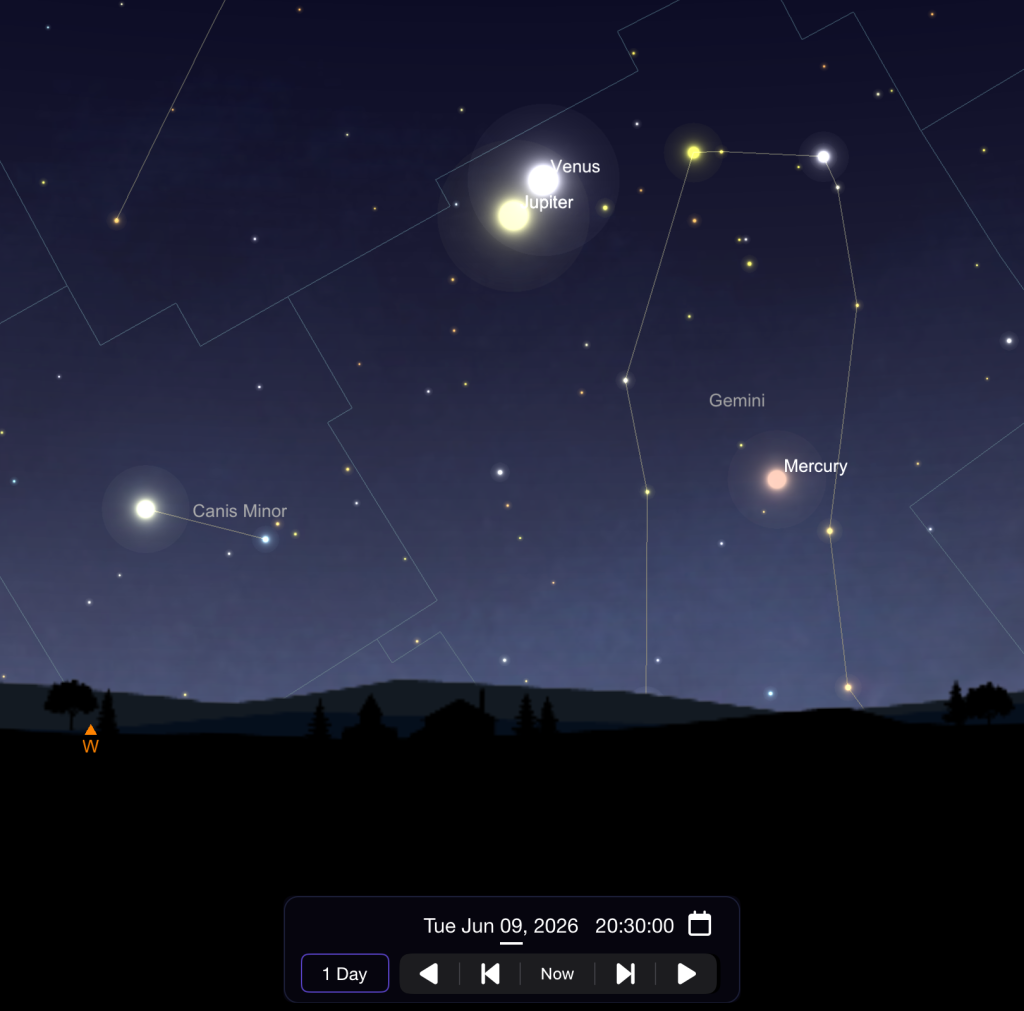
As a bonus, Mercury will be nearby as well and very easy to spot since you can use the two brighter planets as a reference. Mercury is quite bright by itself but because it is so close to the sun it is generally lost in its glare. Now it happens to be close to what’s called its greatest elongation, meaning its largest angular separation from the sun in the sky. Most people have never seen Mercury so this is a good opportunity to do so!
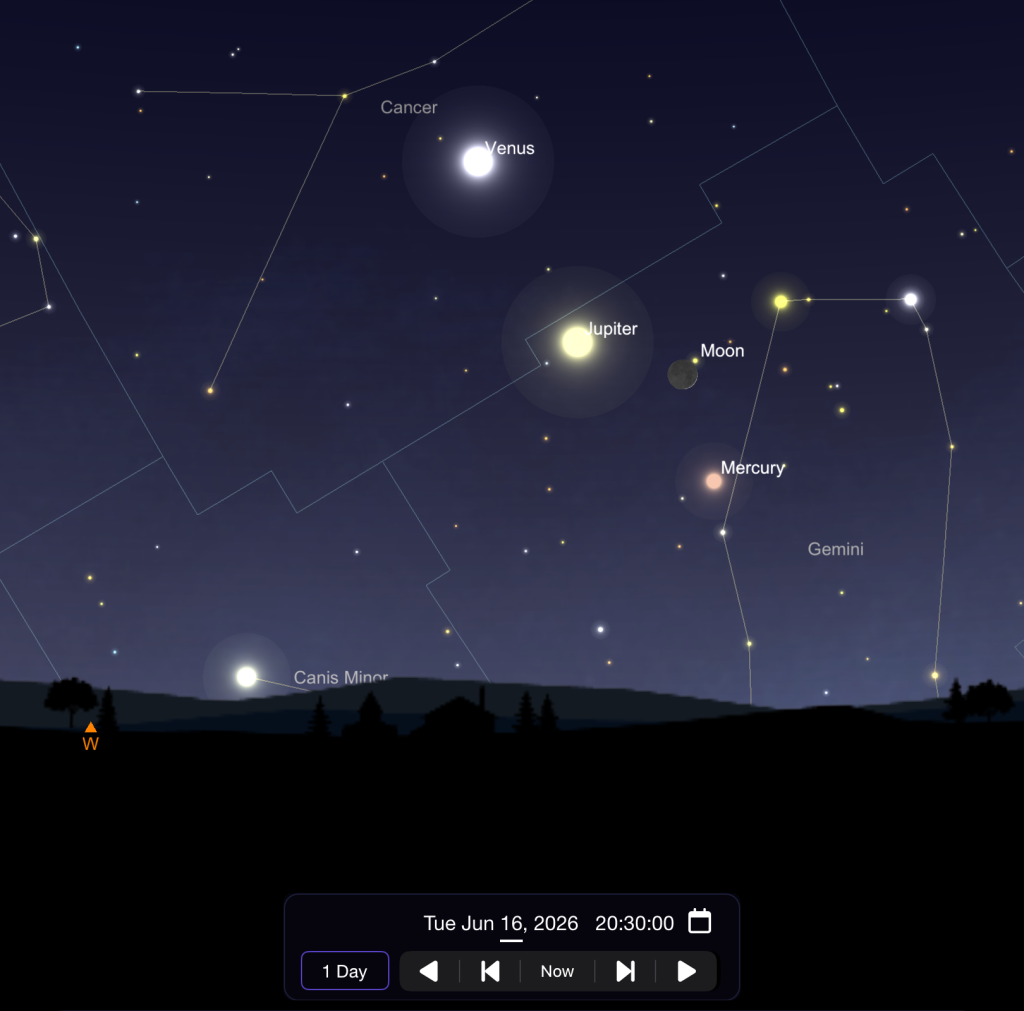
Keep an eye on all three planets over the next week or so and you can see that even after just one day they noticeably change position relative to one another (and relative to bright stars like the Castor and Pollux in Gemini). In about a week they will be more spread out and on Tuesday June 16th they will be joined by a thin, 2-day crescent moon.
Jupiter and Mercury will be getting lower every night but Venus will be visible in the West after sunset for another month or two. As for the other naked-eye planets, Saturn and Mars are visible in the early morning just before sunrise now. I actually saw them not long before writing this post. Both will be evening objects as we get into fall and winter. Jupiter and Mars will have a conjunction around mid-November that will be even closer than the Jupiter-Venus conjunction that’s happening right now! I’ll be posting more about fall and winter planetary events as we head into that time of year.